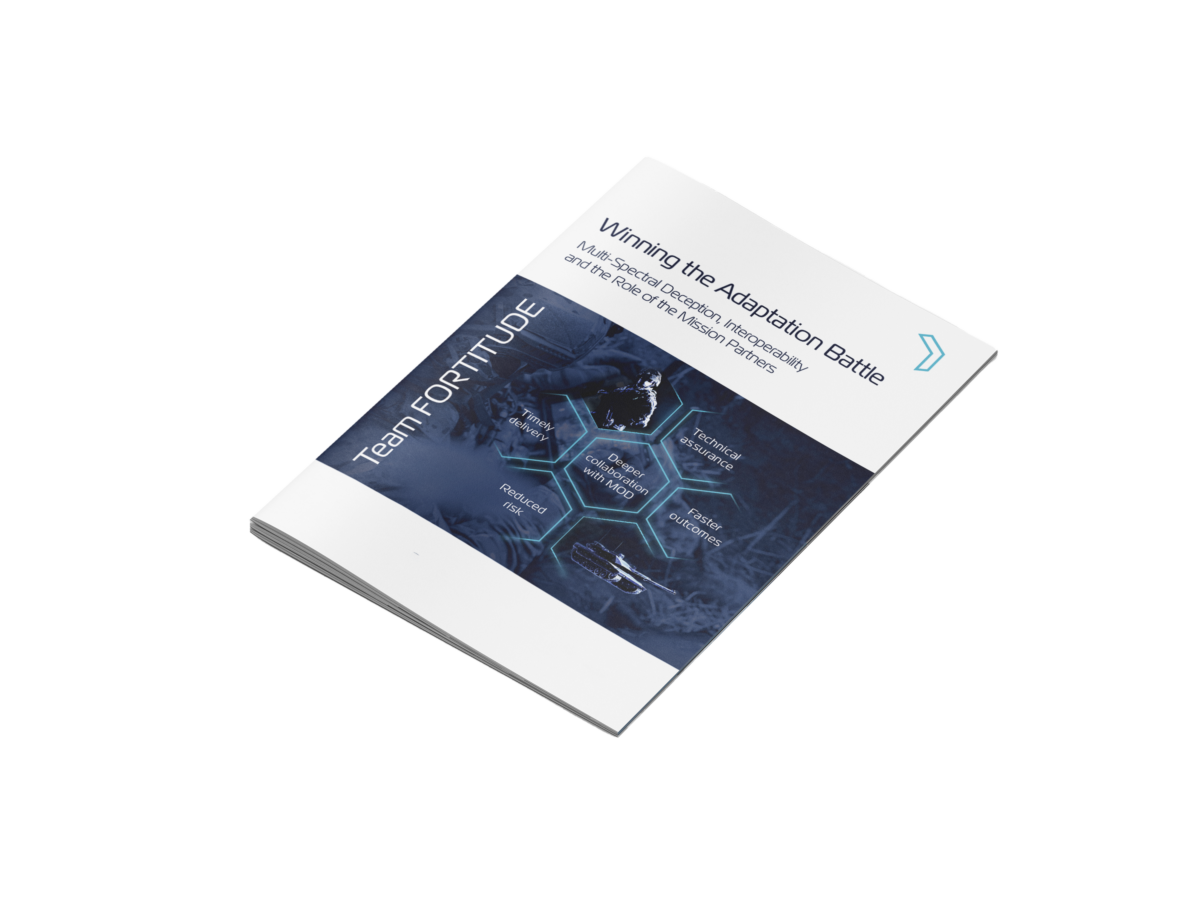
Winning the Adaptation Battle: Why Speed, Integration and Deception Define Modern Warfare
Modern warfare is no longer defined solely by superior firepower or long-term technological dominance. Instead, the decisive advantage lies with the force that can adapt fastest. Lessons from the war in Ukraine have demonstrated that the pace of innovation, adaptation and operational learning now determines success on the battlefield.
Today’s Challenge
Today’s defence environment presents a dual challenge: rapidly adopting emerging technologies while maintaining cohesion across an increasingly complex, multi-domain force. Traditional military acquisition and development cycles—once spanning decades—are no longer fit for purpose. Modern conflict evolves in weeks or months, requiring defence organisations to rethink how they innovate, train and deploy capability.
One of the most significant shifts is in the nature of deception. Historically, deception could rely on a single domain, such as electronic warfare, physical decoys, or information operations. However, advances in sensor fusion have transformed the battlefield. Adversaries now integrate radio frequency, thermal, acoustic, visual and radar data to build a comprehensive picture of the environment. As a result, single-domain deception is no longer effective.
Integration is as vital as innovation
The future lies in integrated multi-spectral deception. This approach synchronises multiple signatures—RF emissions, thermal outputs, visual cues and more—to create a believable alternative reality that can mislead adversaries across all sensing domains. Success depends not on optimising isolated technologies, but on coordinating them effectively within a wider operational system.
Achieving this level of sophistication also requires a fundamental shift in training. Forces must train as they expect to fight—in contested and degraded environments where systems are challenged and disrupted. Realistic experimentation and continuous learning are essential to ensuring that personnel understand how to employ integrated deception within broader operational plans.
“In this rapidly evolving landscape, Mission Partners such as Team FORTITUDE play a critical role,” says Eddie Edwards, PentenAmio’s Director of BD for EW and Tactical Comms. “Working alongside military operators and capability developers, PentenAmio, Filtronic, Mercury EW, 1415 and others are accelerating experimentation, providing specialist expertise and helping to translate emerging technologies into operational advantage. By working together, we’re enabling defence organisations to move quickly from concept to capability.”
“However, innovation alone is not enough,” says Eddie. “The ability to integrate diverse systems into a coherent operational architecture is equally vital. Modern warfare depends on connecting sensors, effectors and decision-makers into a unified network that shares information and coordinates action in real time. Without this integration, even the most advanced technologies will fail to deliver their full potential.”
This is where open interoperability standards become essential. Rather than dictating how systems must be built, these standards define how they communicate. This enables rapid integration of new technologies, particularly those developed by small and medium-sized enterprises, while maintaining flexibility and encouraging ongoing innovation.
Ultimately, the challenge for defence is not choosing between innovation and standardisation, but achieving both simultaneously. Organisations that can innovate rapidly, integrate effectively and adapt continuously will be best positioned to succeed.
As the character of warfare continues to evolve, one truth remains clear: those who master adaptation will win the battle.
Want to learn more?